
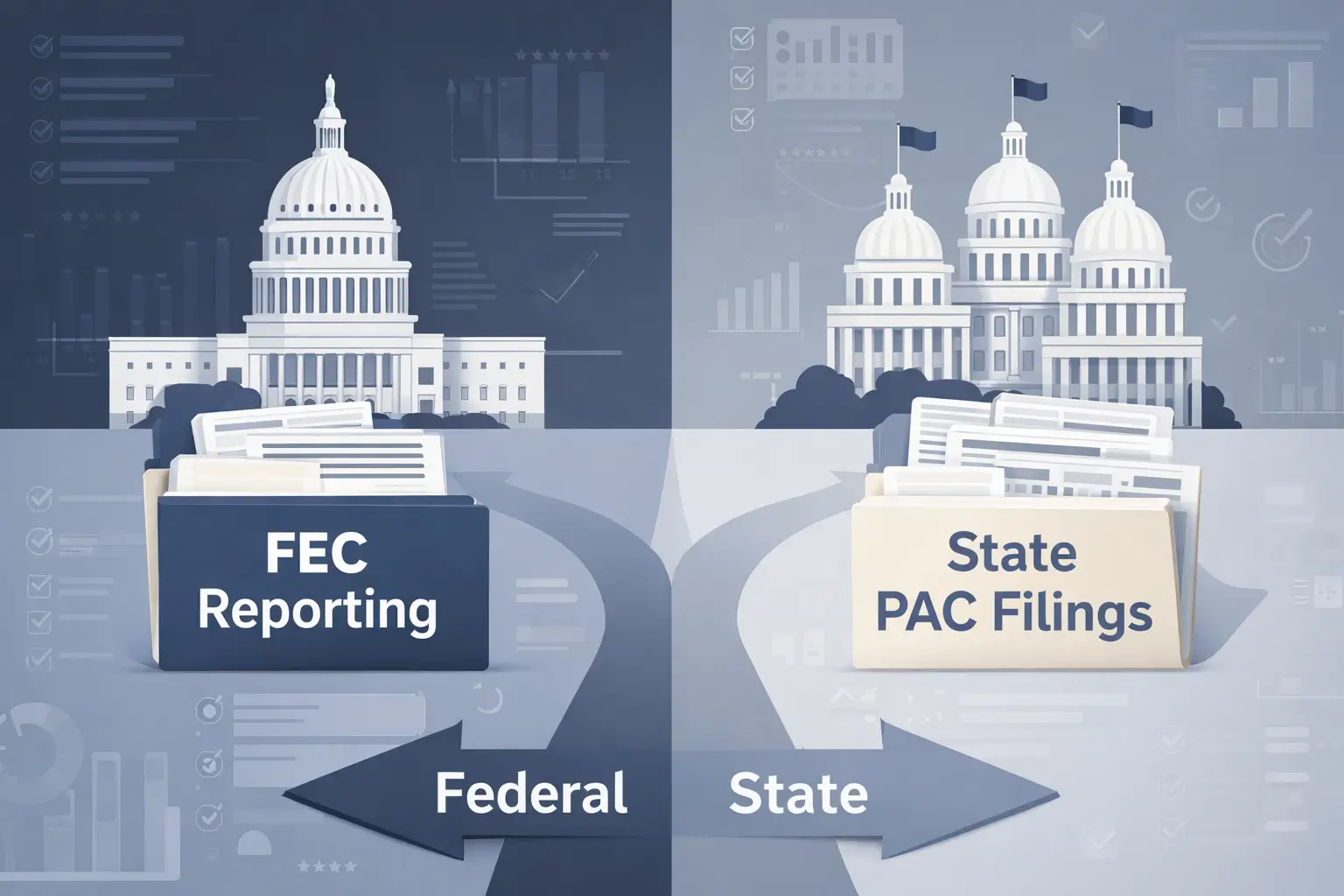
If you are managing a Political Action Committee, one of the most dangerous assumptions you can make is this:
“All PAC reporting works the same.”
It does not.
Understanding federal vs state PAC reporting requirements is critical for treasurers, party committees, and compliance officers. Filing with the wrong authority, missing a state-specific deadline, or misunderstanding jurisdiction differences can trigger enforcement actions, fines, and audit exposure.
This guide breaks down:
- Federal PAC reporting rules
- State PAC filing deadlines
- Dual filing PAC obligations
- FEC vs state election commission authority
- Party committee state compliance
- Multi state political compliance risks
If your committee operates across jurisdictions, this article is essential.
Answer First: What Is the Difference Between Federal and State PAC Reporting
Federal PACs file with the Federal Election Commission.
State PACs file with their respective state election commission.
The rules, deadlines, thresholds, and enforcement processes are not identical.
Some PACs face dual filing PAC obligations when operating across federal and state election activities.
This is where most compliance risk begins.
What Triggers Federal PAC Reporting Rules
A PAC falls under federal PAC reporting rules when:
- It supports or opposes federal candidates
- It raises or spends funds in connection with U.S. House, Senate, or Presidential elections
- It registers with the FEC
Federal PACs must follow:
- Federal PAC reporting rules
- Federal contribution limits
- Federal disclosure requirements
- FEC reporting deadlines
- Pre and post election filing schedules
Federal filings are public and highly scrutinized.
If your PAC supports federal candidates, you must understand your federal campaign reporting timeline thoroughly.
What Triggers State PAC Filing Requirements
A PAC falls under state jurisdiction when:
- It supports state or local candidates
- It participates in ballot initiatives
- It operates within state-only elections
Each state has its own:
- State PAC filing deadlines
- Contribution limits
- Disclosure categories
- Reporting frequency
- Amendment procedures
There is no universal template.
For example:
Florida reporting differs from California.
Texas rules differ from New York.
Some states require monthly reporting. Others quarterly.
Understanding PAC jurisdiction differences is critical to avoid cross-filing errors.
FEC vs State Election Commission: Key Structural Differences
1. Reporting Frequency
Federal PAC reporting rules may require:
- Monthly filing
- Quarterly filing
- Pre and post election reports
States may require:
- Monthly
- Quarterly
- Semi-annual
- Special election filings
- 24-hour independent expenditure reports
2. Enforcement Systems
The FEC operates through formal enforcement processes including:
- Requests for Additional Information
- Audit procedures
- Civil penalties
State election commissions often operate through:
- Administrative fines
- Immediate late penalties
- State-level investigations
3. Disclosure Standards
Federal reporting is standardized nationwide.
State reporting varies widely in:
- Donor disclosure thresholds
- Employer information requirements
- Independent expenditure rules
- Electronic filing standards
This is where multi state political compliance becomes complex.
Dual Filing PAC Obligations Explained
Some PACs must file at both levels.
This happens when:
- A federal PAC makes contributions to state candidates
- A state PAC engages in federal election activity
- A party organization supports both federal and state candidates
- A hybrid PAC operates across jurisdictions
Dual filing PAC obligations often lead to:
- Confusion about which contributions belong where
- Misclassification of disbursements
- Overlapping reporting periods
- Filing under incorrect authority
This is one of the most common causes of compliance breakdown.
If your organization manages multiple committees, review structured PAC compliance and FEC filing support to reduce cross-jurisdiction exposure.
Party Committee State Compliance Risks
Party committees face some of the most complex reporting obligations.
They often:
- Operate federal accounts
- Maintain state accounts
- Engage in coordinated activity
- Support multiple candidate types
Party committee state compliance failures usually arise from:
- Mixing federal and non-federal funds
- Incorrect reporting categories
- Inconsistent allocation methods
- Misunderstanding FEC vs state election commission boundaries
This is not just paperwork. It is a governance risk.
If your organization operates in this category, structured party committee compliance oversight is critical.
Multi State Political Compliance: The Growing Risk
As campaigns scale digitally, PACs increasingly operate across multiple states.
This creates:
- Multi state political compliance exposure
- Overlapping reporting schedules
- Varying donor thresholds
- Differing disclaimer rules
For example:
A committee supporting federal candidates in one state and ballot initiatives in another may trigger:
- FEC reporting
- State filing
- Separate independent expenditure reports
Failure to structure reporting systems correctly results in cascading errors.
Most Common Federal vs State Reporting Mistakes
Even experienced treasurers make these errors:
- Filing federal contributions in state reports
- Missing state PAC filing deadlines due to federal calendar reliance
- Assuming federal thresholds apply at state level
- Failing to amend one jurisdiction after correcting another
- Misunderstanding dual filing PAC obligations
These are not rare mistakes. They are routine enforcement triggers.
How to Build a Compliant Reporting Structure
To manage federal vs state PAC reporting requirements effectively, committees should:
- Clearly separate federal and state accounts
- Maintain jurisdiction-specific reporting calendars
- Implement structured contribution classification systems
- Conduct pre-filing compliance reviews
- Monitor overlapping election cycles
Software can assist with scheduling.
But compliance oversight ensures reporting accuracy across jurisdictions.
Why This Complexity Is Increasing
Regulators now use:
- Automated data matching
- Cross-agency transparency tools
- Public database scrutiny
- AI-assisted reporting review
Errors in one jurisdiction are increasingly visible in another.
Multi state political compliance is no longer a niche issue. It is mainstream governance risk.
FAQ: Federal vs State PAC Reporting Requirements
Yes. Dual filing PAC obligations apply when committees engage in activity across jurisdictions.
No. Each state sets its own reporting calendar and requirements.
No. State election commissions enforce state-level reporting.
Yes. Party committee state compliance often includes both federal and state obligations.
Misclassification of funds and failure to file correctly in one jurisdiction while focusing on another.
Why Professional Oversight Matters
Federal vs state PAC reporting requirements are not interchangeable.
They demand:
- Jurisdiction clarity
- Regulatory interpretation
- Filing accuracy
- Structured oversight
If your committee operates across federal and state elections, you should not rely on assumptions or templates from other jurisdictions.
Explore structured campaign finance compliance systems that align federal and state reporting into one unified compliance framework.
Final Call to Action
If your PAC operates across jurisdictions or you are unsure whether your reporting structure properly separates federal and state obligations, now is the time to act.
Compliance errors multiply when oversight is reactive.
Contact Computare Partners to build a reporting structure that protects your committee across every jurisdiction.
Federal vs state reporting is not a minor distinction.
It is a structural compliance decision that determines whether your PAC operates safely or stays exposed.