
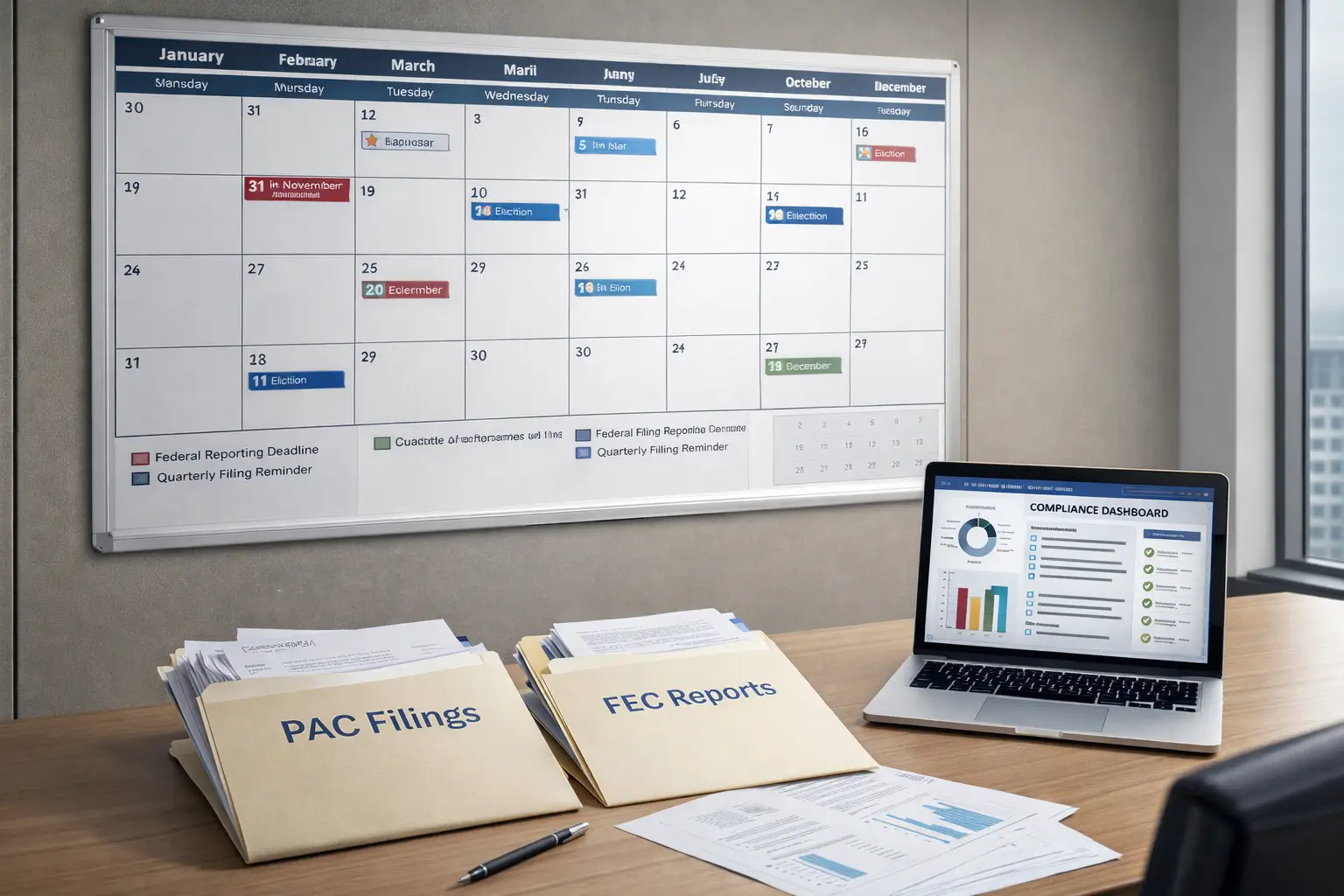
An FEC compliance calendar for PACs is not optional. It is the backbone of every compliant political action committee.
Missed filings trigger fines. Late amendments trigger audits. Inaccurate reports damage credibility.
If you are a PAC treasurer or compliance officer, building a structured federal campaign reporting timeline is one of the most important risk management steps you can take.
This guide walks you through how to create a year-round campaign finance reporting calendar that keeps your committee protected in 2026 and beyond.
What Is an FEC Compliance Calendar for PACs
An FEC compliance calendar for PACs is a structured, annual filing roadmap that tracks every federal reporting obligation required by the Federal Election Commission.
It includes:
- Federal PAC filing schedule
- PAC quarterly filing dates
- Monthly filing deadlines
- FEC pre and post election reports
- PAC year end report deadline
- Special election reporting windows
- Independent expenditure reports
It ensures nothing is missed and every deadline is tracked proactively.
Step 1: Identify Your PAC Filing Frequency
The first step in building a federal PAC filing schedule is determining whether your committee files monthly or quarterly.
Monthly Filers
- File every month
- Covers prior month activity
- Often used by leadership PACs and connected committees
- More consistent reporting cadence
Quarterly Filers
- Q1 Report
- Q2 Report
- Q3 Report
- Year-End Report
- Additional pre-election and post-election reports during active cycles
Your campaign finance reporting calendar must reflect the correct cadence. Filing frequency changes the entire compliance structure.
Step 2: Map Out the Federal Campaign Reporting Timeline
After identifying your filing type, create a visual 12-month federal campaign reporting timeline.
Include:
- All PAC quarterly filing dates
- Monthly report deadlines if applicable
- FEC reporting deadlines 2026
- Election-specific reporting windows
- PAC year end report deadline
- Runoff or special election triggers
This should be documented in:
- A shared compliance tracker
- Calendar reminders
- Internal compliance checklist
- Treasurer oversight system
This structured timeline prevents reactive compliance behavior.
Step 3: Account for FEC Pre and Post Election Reports
Many compliance failures occur during election cycles.
Your FEC compliance calendar for PACs must include:
- 12-day pre-election reports
- 10-day post-election reports
- 48-hour independent expenditure reports
- 24-hour independent expenditure reports
These reports operate on different timelines than standard quarterly filings.
They must be treated as high-risk windows within your campaign finance reporting calendar.
Step 4: Add Amendment and Correction Windows
Compliance does not end after submission.
Your calendar must include monitoring periods after every filing date.
Include:
- RFAI response deadlines
- Amendment filing windows
- Correction reviews
- Internal reconciliation checks
This integrates with PAC compliance and FEC filing support systems that go beyond simple submission.
If your PAC needs structured oversight, review our PAC compliance and FEC filing support services to understand how proactive review prevents enforcement risk.
Step 5: Track State-Level Overlap if Applicable
If your committee also files at the state level or is affiliated with a party organization, you may face dual reporting obligations.
Your compliance calendar must account for:
- State reporting deadlines
- Party committee compliance requirements
- Hybrid PAC dual filings
- Multi-jurisdiction reporting timelines
Ignoring state-level coordination creates overlapping compliance gaps.
Step 6: Build Internal Controls Around the Calendar
An FEC compliance calendar for PACs only works if internal controls support it.
Best practices include:
- Treasurer sign-off checklist before filing
- Contribution aggregation monitoring
- Disbursement classification review
- Independent expenditure tracking system
- Data reconciliation before submission
Strong internal controls reduce the risk of FEC compliance violations that trigger audits.
Step 7: Prepare for FEC Reporting Deadlines 2026
Every election cycle brings new enforcement scrutiny.
Your FEC reporting deadlines 2026 plan should include:
- Updated federal PAC filing schedule
- Confirmed election dates
- Adjusted pre and post election reporting windows
- Updated contribution limit thresholds
- Year-end reconciliation preparation
A forward-looking compliance calendar is more important than a reactive one.
Common Mistakes When Building a Campaign Finance Reporting Calendar
Even experienced PAC treasurers make these errors:
- Forgetting special election triggers
- Missing independent expenditure reporting thresholds
- Misclassifying report type
- Failing to amend incorrect filings
- Ignoring RFAI response windows
- Not aligning federal and state reporting timelines
These mistakes often lead to FEC correspondence and enforcement review.
Why a Structured FEC Compliance Calendar Protects PAC Treasurers
A PAC treasurer is personally responsible for timely and accurate reporting.
A structured FEC compliance calendar for PACs:
- Reduces personal liability exposure
- Prevents late filing penalties
- Improves audit readiness
- Enhances internal transparency
- Strengthens campaign governance
If you are unsure whether your compliance structure is audit-ready, explore our campaign finance reporting services designed for treasurers who need structured oversight.
Example Framework: What Your PAC Calendar Should Include
Your annual compliance tracker should contain:
Month
Filing Type
Coverage Period
Submission Deadline
Internal Review Date
Amendment Monitoring Window
Responsible Officer
This transforms your federal campaign reporting timeline into an operational compliance system rather than a static date list.
FAQ: FEC Compliance Calendar for PACs
It includes monthly or quarterly report deadlines, pre and post election reports, independent expenditure reports, and year-end filings.
Use an annual compliance tracker with automated reminders and treasurer oversight checkpoints.
Year-end reports are typically due January 31 for quarterly filers but may vary depending on filing frequency.
Core structure remains consistent, but election-specific reporting windows and calendar dates shift each year.
It reduces enforcement risk, ensures compliance accuracy, and protects the treasurer from personal liability.
Final Thoughts
An FEC compliance calendar for PACs is not a spreadsheet exercise. It is a governance system.
The difference between compliant PACs and penalized PACs is rarely knowledge. It is structure.
If your committee wants a fully managed federal PAC filing schedule with oversight, monitoring, and review, contact Computare Partners to build a compliance system that protects your organization year-round.
Proactive compliance always costs less than enforcement.